Week 1: Why logic, and where it came from
Goal. See where logic came from, why it became an algebra, and how that algebra ended up running inside a chip. This is the story the whole course retells in hardware.
From argument, to algebra, to electronics
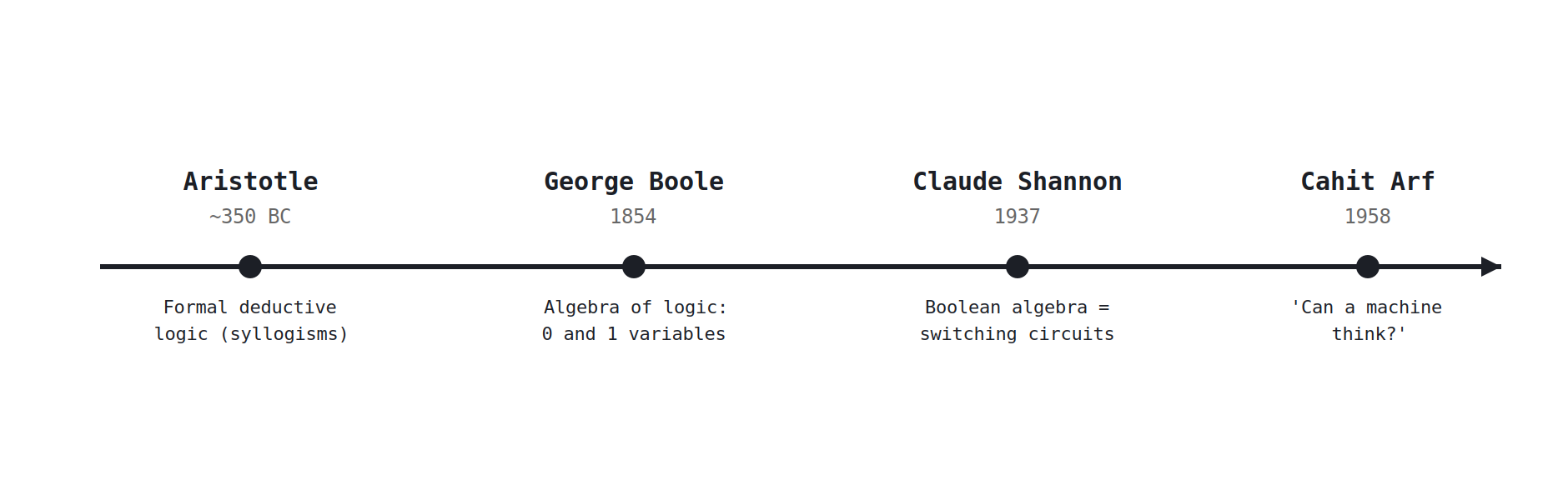
- Aristotle systematised deductive reasoning. Against the sophists, who taught how to win arguments, he asked what makes an argument valid regardless of who makes it, and wrote down the rules. That is logic as the structure of correct reasoning.
- George Boole turned that verbal logic into an algebra. In The Laws of Thought (1854) a proposition is a variable that is either 1 (true) or 0 (false), and AND, OR, NOT are its operations. Reasoning becomes calculation.
- Claude Shannon connected the algebra to electricity. His 1937 thesis showed that a network of switches obeys Boolean algebra exactly, so you can design a circuit by writing an expression. This is the moment logic became hardware.
- Cahit Arf, the Turkish mathematician, gave a 1958 lecture asking “Can a machine think?” We include him deliberately: this chain of ideas is not the property of one country or tradition. Knowledge is humanity’s, and Arf’s question is exactly the one a machine built from gates makes you ask.
Why this is the spine of the course
Argument became algebra, algebra became switches, switches became computers. We will walk that same path from the bottom: start with gates, learn the one method for designing with them, and finish by assembling a small microcontroller that runs a program. Everything in between earns its place as a piece of that machine.
From operators to gates to computers
Boole’s three operators are the three basic gates: AND, OR, and NOT, which you meet properly in Week 3. A gate is one operator built in silicon; a handful of gates make an adder; many adders, registers, and a little memory make a computer. The distance from “true and false” to “a running program” is just a lot of the same simple steps.
How this course works
One method: every circuit comes from a truth table, through minterms, to gates. One goal: a working 4-bit MCU at the end. We favour depth over coverage, mastering a few fundamentals completely rather than skimming many, because a fundamental understood well is something you can always build on later.
Check yourself / to discuss
- What separates a valid argument from one that is merely persuasive? Why did that distinction matter to Aristotle?
- Boole wrote his algebra 80 years before any electronic computer. Why was Shannon’s 1937 link between that algebra and switching circuits such a turning point?
- Arf asked whether a machine can think. After building this course’s MCU, how would you answer?