Week 7 — Behavioral Modeling (Combinational)
The historical idea
The highest-level combinational style: describe what the circuit does with procedural
statements — if-else, case — inside always @(*). After this week combinational logic is
complete and the midterm follows.
Objectives
- Use
always @(*)for combinational behaviour. - Use
if-elseandcase. - Use vectors / port ranges (
input wire [1:0] sel,output reg [3:0] B). - Read/write binary, decimal, hex literals (
4'd5,4'b0101,8'hA3). - Know why
alwaysoutputs arereg, and why full assignment avoids latches.
Concept (short)
Any signal assigned inside an always block must be reg. For combinational behaviour use
always @(*) and assign the output on every path (or set a default), else the tool infers
a latch. case is the clean multi-way form. Number literals are <size>'<base><value>.
Example 1 — 2-to-1 MUX with if-else
design.v
module mux_2to1_ifelse(
    input  wire a,    // input 0
    input  wire b,    // input 1
    input  wire sel,  // select
    output reg  y
);
    always @* begin
        if (sel) y = b;
        else     y = a;
    end
endmodule
▶ Open in VeriSim — loads
w07_mux_2to1_ifelse.v+w07_mux_2to1_ifelse_tb.vand runs (Verilog-2005).
Example 2 — the same MUX with case
design.v
module mux_2to1_case(
    input  wire a, b, sel,
    output reg  y
);
    always @* begin
        case (sel)
            1'b0:    y = a;
            1'b1:    y = b;
            default: y = a;
        endcase
    end
endmodule
▶ Open in VeriSim — loads
w07_mux_2to1_case.v+w07_mux_2to1_case_tb.vand runs (Verilog-2005).
Example 3 — 4-to-1 MUX with a vector select (port range)
design.v
module mux4to1(
    input  wire [1:0] sel,    // 2-bit selection
    input  wire a, b, c, d,
    output reg  y
);
    always @* begin
        case (sel)
            2'b00: y = a;
            2'b01: y = b;
            2'b10: y = c;
            2'b11: y = d;
        endcase
    end
endmodule
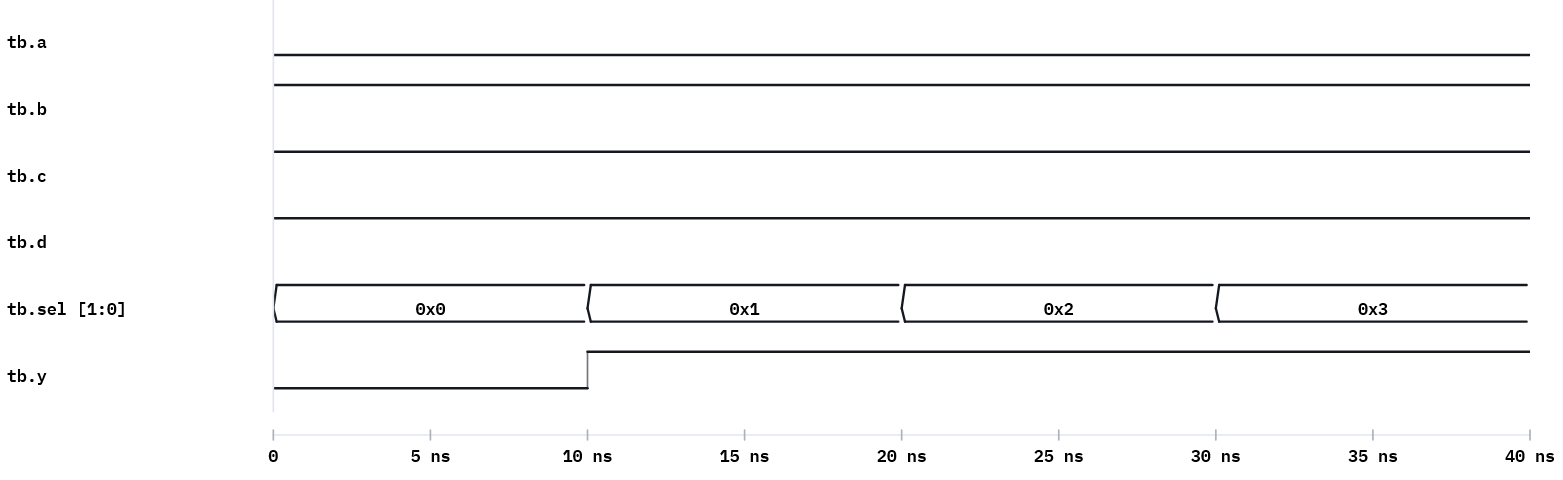
testbench.v
`timescale 1ns/1ns
module tb;
    reg [1:0] sel; reg a,b,c,d; wire y;
    mux4to1 M0(.sel(sel), .a(a), .b(b), .c(c), .d(d), .y(y));
    initial begin
        $dumpfile("dump.vcd"); $dumpvars(0, tb);
        $monitor("Time=%0t sel=%b a=%b b=%b c=%b d=%b y=%b", $time, sel,a,b,c,d,y);
        a=0; b=1; c=1; d=1;
        sel=2'b00; #10;
        sel=2'b01; #10;
        sel=2'b10; #10;
        sel=2'b11; #10;
        $finish;
    end
endmodule
Expected Console
Time=0 sel=00 a=0 b=1 c=1 d=1 y=0
Time=10 sel=01 a=0 b=1 c=1 d=1 y=1
Time=20 sel=10 a=0 b=1 c=1 d=1 y=1
Time=30 sel=11 a=0 b=1 c=1 d=1 y=1
▶ Open in VeriSim — loads
w07_mux4to1.v+w07_mux4to1_tb.vand runs (Verilog-2005).
Example 4 — case with number literals (exam style)
Output a chosen value depending on a 1-bit input — the student_id_output idea.
design.v
module digit_select(input A, output reg [3:0] B);
    always @(*) begin
        case (A)
            1'b0:    B = 4'd5;     // e.g. last digit of an ID
            1'b1:    B = 4'd4;     // second-to-last digit
            default: B = 4'd0;
        endcase
    end
endmodule
The same function as a single dataflow conditional (to show equivalence):
module digit_select_df(input A, output [3:0] B);
    assign B = (A == 0) ? 4'd5 : 4'd4;
endmodule
▶ Open in VeriSim — loads
w07_digit_select.v+w07_digit_select_tb.vand runs (Verilog-2005).
Run it in VeriSim
- Run examples 1 and 2; confirm
if-elseandcasegive the same MUX behaviour. - Run example 3 → the
Time=… y=…table above. - Run example 4 both ways (
caseand conditionalassign) and confirm identical outputs — style is description, not implementation. - Latch trap: delete the
2'b11branch frommux4to1(no default) and note the missing assignment would infer a latch in synthesis (Week 10). Adddefault:to stay combinational.
What to look for
regvswire:case/alwaysoutputs arereg;assignoutputs arewire. Mixing these is the most common Week-7 compile error.- Assign the output on every path in
always @(*)(or set a default at the top).
Exercises (session 2)
- Decoder, behavioral. 2-to-4 decoder with
case; self-check (exactly one bit high). - Number literals. Output
8'hA3whenA=1,8'b0000_1111whenA=0; confirm on the waveform. - Priority encoder. 4-input priority with
if-else if; explain why order matters here but not inmux4to1. - 2-to-1 to 4-to-1. Build a 4-to-1 MUX by nesting two
mux_2to1_caseinstances and a selector; compare with the flatcaseversion.
Midterm checkpoint. Students can now: transcribe a circuit to primitives, write proper and self-checking testbenches, build hierarchy, reason about timing/glitches, and model combinational logic three ways (gate / dataflow / behavioral).