Week 3 — Catching Wrong Designs
The historical idea
A testbench is only useful if it catches mistakes. We move from “watch the output” to “let the testbench judge it.” Three levels: (1) check by eye against the truth table, (2) self-checking testbenches that compare to expected values, (3) test-vector tables that drive many cases automatically.
Objectives
- Compare simulated outputs to a hand-computed truth table.
- Diagnose a deliberately wrong design from the testbench output.
- Write a self-checking testbench that prints PASS/FAIL and counts errors.
- Use
===/!==(not==/!=) so unknown (x) and high-Z (z) are caught. - Drive a DUT from a test-vector table.
Example 1 — The “wrong full adder” (find the bug)
This is the slide’s wrong design: gate G3 uses W2 where it should use W1.
design.v (buggy on purpose)
// full adder - WRONG DESIGN
module fulladder(
    output S, Co,
    input  A, B, Ci
);
    wire W1, W2, W3;
    xor G0 (W1, A, B);
    xor G1 (S,  W1, Ci);
    and G2 (W2, A, B);
    and G3 (W3, Ci, W2);   // BUG: should be (W3, Ci, W1)
    or  G4 (Co, W2, W3);
endmodule
Test it against the truth table and watch specific rows fail. Then fix G3 to use W1.
testbench.v (truth-table print)
`timescale 1ns/1ns
module tb;
    reg [2:0] in; wire S, Co; integer i;
    fulladder M0(.S(S), .Co(Co), .A(in[2]), .B(in[1]), .Ci(in[0]));
    initial begin
        $dumpfile("dump.vcd"); $dumpvars(0, tb);
        $display("A B Ci : Co S");
        for (i=0;i<8;i=i+1) begin in=i; #10;
            $display("%b %b  %b :  %b %b", in[2],in[1],in[0],Co,S); end
        $finish;
    end
endmodule
▶ Open in VeriSim — loads
w03_fulladder_buggy.v+w03_fulladder_buggy_tb.vand runs (Verilog-2005).
Compare the printed Co column with the correct one (Week 2, example 2). The wrong design
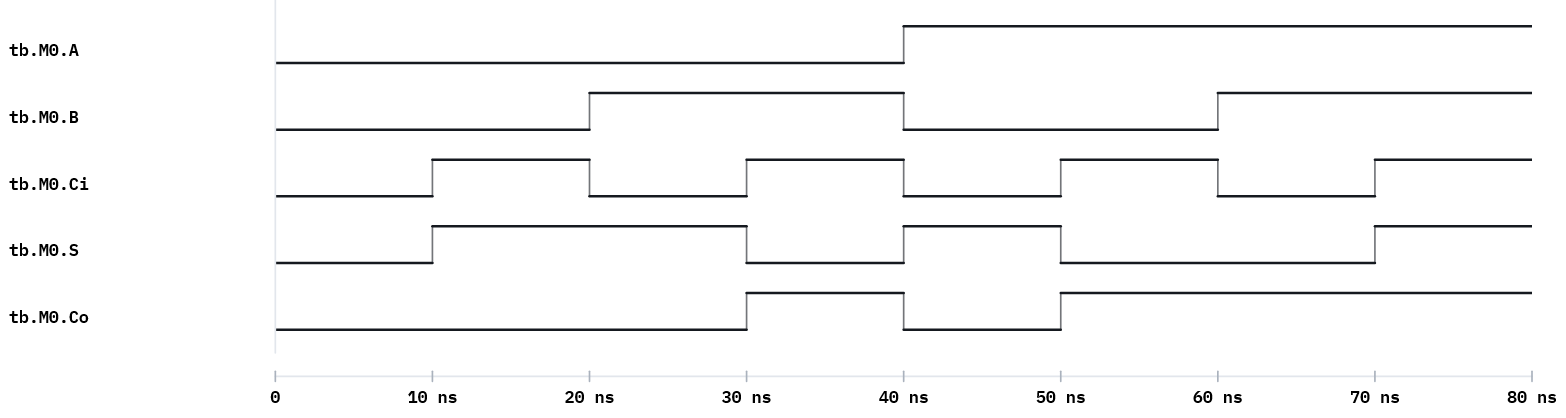
miscomputes the carry for the cases where Ci=1 and A,B differ.
Example 2 — Self-checking testbench
Let the testbench compare against a reference and report failures automatically.
design.v — the correct fulladder (G3 uses W1).
testbench.v
`timescale 1ns/1ns
module tb;
    reg  [2:0] in; wire S, Co;
    integer i, errors = 0;
    reg [1:0] expect;                       // {Co, S}
    fulladder M0(.S(S), .Co(Co), .A(in[2]), .B(in[1]), .Ci(in[0]));
    initial begin
        $dumpfile("dump.vcd"); $dumpvars(0, tb);
        for (i=0;i<8;i=i+1) begin
            in = i; #10;
            expect = in[2] + in[1] + in[0]; // reference model
            if ({Co,S} !== expect) begin
                $display("FAIL A=%b B=%b Ci=%b -> got {Co,S}=%b%b expected %b",
                          in[2],in[1],in[0],Co,S,expect);
                errors = errors + 1;
            end
        end
        if (errors==0) $display("ALL TESTS PASSED");
        else           $display("%0d TEST(S) FAILED", errors);
        $finish;
    end
endmodule
▶ Open in VeriSim — loads
w03_fulladder.v+w03_fulladder_tb.vand runs (Verilog-2005).
Expected Console: ALL TESTS PASSED. Put the buggy design back and the same testbench
prints FAIL lines and a non-zero count — proof the test works.
Use
!==, not!=.!=returns unknown if an operand isx, so an undriven output can slip through;!==comparesx/zconcretely and reports it.
Example 3 — Test-vector table
Store inputs and expected outputs together; loop over them.
testbench.v
`timescale 1ns/1ns
module tb;
    reg  [2:0] in; wire S, Co;
    integer i, errors = 0;
    // each vector: {A, B, Ci, expected_Co, expected_S}
    reg [4:0] vec [0:3];
    fulladder M0(.S(S), .Co(Co), .A(in[2]), .B(in[1]), .Ci(in[0]));
    initial begin
        $dumpfile("dump.vcd"); $dumpvars(0, tb);
        vec[0]=5'b000_00; vec[1]=5'b011_10; vec[2]=5'b101_10; vec[3]=5'b111_11;
        for (i=0;i<4;i=i+1) begin
            in = vec[i][4:2]; #10;
            if ({Co,S} !== vec[i][1:0]) begin
                $display("FAIL vector %0d", i); errors = errors + 1; end
        end
        if (errors==0) $display("VECTORS PASSED");
        else           $display("VECTORS FAILED: %0d", errors);
        $finish;
    end
endmodule
▶ Open in VeriSim — loads
w03_fulladder_v2.v+w03_fulladder_v2_tb.vand runs (Verilog-2005).
Run it in VeriSim — then break it on purpose
- Run example 2 → ALL TESTS PASSED.
- Swap the correct design for the buggy one → specific FAIL lines + a count.
- Line up a failing time on the Waveform with its FAIL message using the cursor.
What to look for
- A good testbench fails loudly when the design is wrong. If breaking the design produces no failure, the testbench is not checking the right thing.
- The wrong full adder fails only on certain rows; predicting which rows from the bug is the real skill.
Exercises (session 2)
- Wrong half adder. Swap
and/oron the carry gate; predict whichab:csrows fail before running, then confirm with a self-checking testbench. - Decoder check. Write a self-checking testbench for the 2-to-4 decoder (exactly one output low when enabled; all high when disabled).
- x-detection. Leave one output net undriven and show an
!==check flagsxwhile an!=check does not. - Vector file. Add two vectors with intentionally wrong expected values; confirm the testbench flags exactly those.